

One of the Education Financing Observatory’s monitoring dimensions, “Availability of Resources”, is an indicator that calculates the per capita public education budget available for each school-age person, whether enrolled or not. By combining data from UNESCO Institute for Statistics (UIS) and the World Bank databases, it covers pre-primary, primary, and secondary education levels and is expressed in current US dollars per capita, providing insights into the resources available to meet every learner’s needs.
This indicator allows for the tracking of inequalities across countries. A comparative analysis including Organisation for Economic Co-operation and Development (OECD) countries shows that disparities between OECD countries and the rest of the world remain staggering. On average, OECD countries invest ten times more per student than low-income countries, reflecting deep and persistent inequities in global education financing.
The graphs below illustrate this gap, with significant variation across countries. By comparing regional averages since 2015, the first shows investment per student in each region as a proportion of the OECD average. For example, in 2015, countries in Latin America and the Caribbean invested only 23% of what OECD countries invested per student.
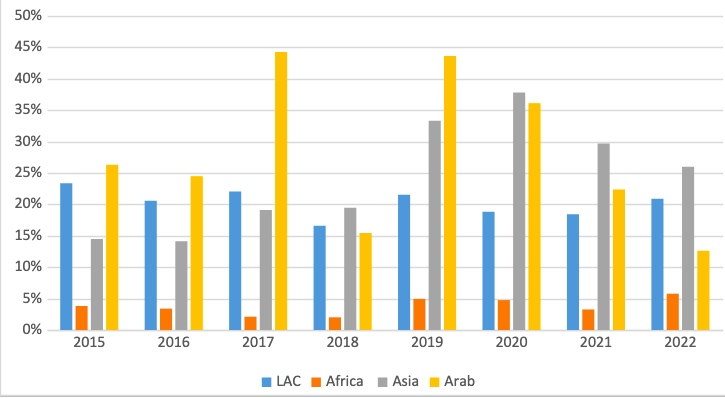
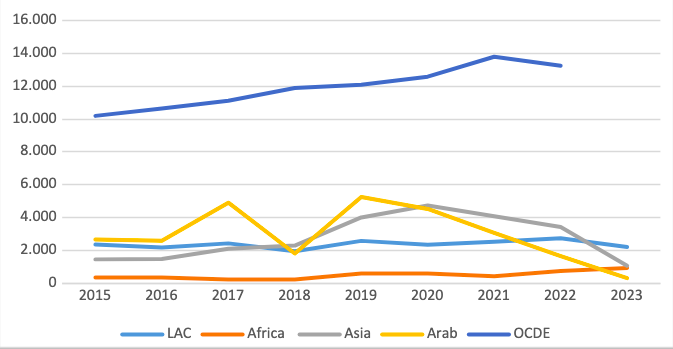
The second graph presents the same data in dollar values per capita, highlighting how these inequalities have evolved over time. The distance between the lines visualises the structural imbalance—a clear picture of how far the world still is from achieving equity in education investment.
Across OECD countries, annual expenditure per student averages about USD 10,700 at the primary level, USD 11,900 at the secondary level, and USD 18,100 at the tertiary level. By contrast, in many low-income countries, investment barely reaches a few hundred dollars per student.
This imbalance is not only economic—it is a matter of justice and rights. Ensuring that every learner receives adequate resources requires rethinking global financing priorities and mobilising fair, sustained investments across all regions.